Home
HomeHow a Small Distributor in the Philippines Built a Solar Business with Just 20 Solar Panels
 Aug 21,2026

 Vevsun
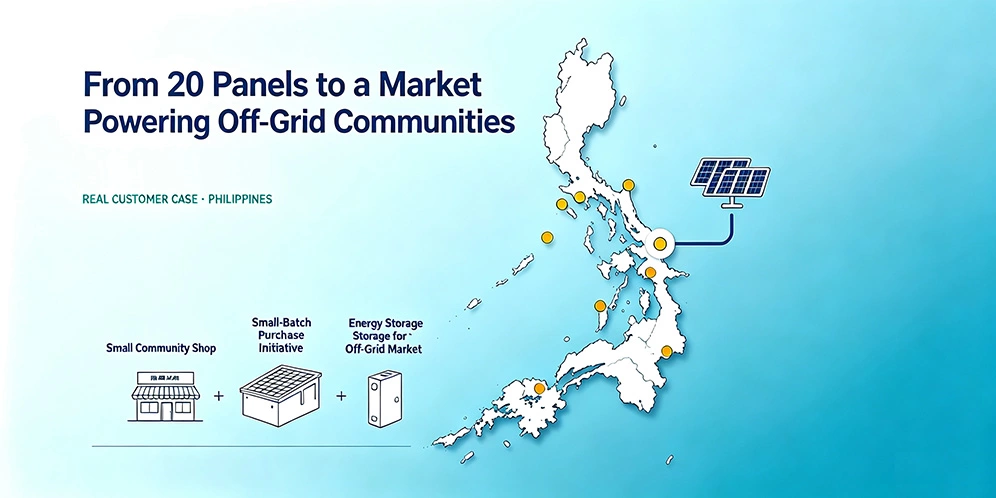
How a Small Distributor in the Philippines Built a
Solar Business with Just 20 Solar Panels?
In the Philippines, there are over 7,600 islands, many of which are not covered by the national power grid. Diesel generators cost as much as $0.45-0.60 per kilowatt-hour, placing a significant burden on local small shops and farms.
This article shares a real-world case study: how Mark, a small wholesaler in Manila, Philippines, leveraged a single small-batch purchase to tap into his community's off-grid solar market.
01: Background: From Appliance Repair to Solar Installation
Mark used to run an appliance repair shop in the suburbs of Manila, fixing fans, televisions, and refrigerators for local residents.
He discovered that many of his customers shared a common problem: power outages.
The local power grid was unstable, experiencing outages at least 2-3 times a week, each lasting from several hours to half a day. To maintain lighting and fans, his small shop had to buy diesel generators. However, with rising fuel prices, a small generator cost 200-300 pesos (about $4-6) per day, resulting in electricity bills exceeding $150 per month—a significant burden for a small shop.
Mark realized that if he could solve the power outage problem with solar energy, he might find a new business opportunity.
01: Background: From Appliance Repair to Solar Installation
Mark used to run an appliance repair shop in the suburbs of Manila, fixing fans, televisions, and refrigerators for local residents.
He discovered that many of his customers shared a common problem: power outages.
The local power grid was unstable, experiencing outages at least 2-3 times a week, each lasting from several hours to half a day. To maintain lighting and fans, his small shop had to buy diesel generators. However, with rising fuel prices, a small generator cost 200-300 pesos (about $4-6) per day, resulting in electricity bills exceeding $150 per month—a significant burden for a small shop.
Mark realized that if he could solve the power outage problem with solar energy, he might find a new business opportunity.
However, he faced three real difficulties:
He didn't understand how to configure a solar system—inverters, panels, and batteries were completely unfamiliar to him:
a. He didn't have a large amount of capital to stock up on inventory—he only had about $500 in spare cash to try it out;
b. No one taught him how to install it—off-grid kits were unavailable locally, and no one provided installation training.
c. He tried finding local suppliers, but Philippine solar products were expensive and had limited selection. So he started searching online and eventually found me through Google search to our website.
02: Communicating Needs: A Clear, Small Goal
Mark sent me an inquiry via Google search, with a very simple requirement:
“I want to solve a power outage problem for a small shop. The shop needs: 3 LED lights + 1 fan + 1 small freezer. The budget is around $700. Ideally, I'd also like to learn how to install it.”
This requirement is typical—not a large project, but real, specific, and with the potential for repeat purchases.
Based on his situation, I configured a small off-grid solar system for him:
|
Item |
Matched products |
Quantity(pcs) |
|
Solar panel |
590W A grade monocrystalline solar panel |
2pcs |
|
Inverter |
3kW Pure Sine Wave Solar hybrid inverter |
1pc |
|
Battery |
12V 200Ah Gel battery |
2pcs |
|
Accessories |
Solar cable, MC4 connector, Solar mounting bracket, etc. |
1 set |
This configuration is sufficient to power:
-3 LED lights (approx. 30W) – 8-10 hours of illumination
-1 fan (approx. 75W) – over 12 hours of operation
-1 mini freezer (approx. 100W) – 8-10 hours of operation (depending on battery capacity)
-1 home use TV, etc.
The entire system, including sea freight, costs approximately $730.
This is the amount of cargo that can be loaded onto a pallet. Shipping by LCL (Less than Container Load) to Manila port takes approximately 15-20 days.
03: Beyond the Product Itself: A "Foolproof" Installation Guide
Mark had never installed a solar system before. To help him install it smoothly, I did one thing: I drew a simple wiring diagram with accompanying photos and instructions in both Chinese and English.
The diagram included:
a. How to connect the panels in series/parallel
b. How to connect the inverter to the battery
c. How to connect the load
d. Grounding precautions
At the same time, I sent him several short installation videos, no more than 2 minutes long, filmed with a mobile phone. The image quality wasn't great, but every step was clear.
I told him: "Install your own store first. Once it's installed well, it'll be a living advertisement."
04: Results: Changes After the First Order
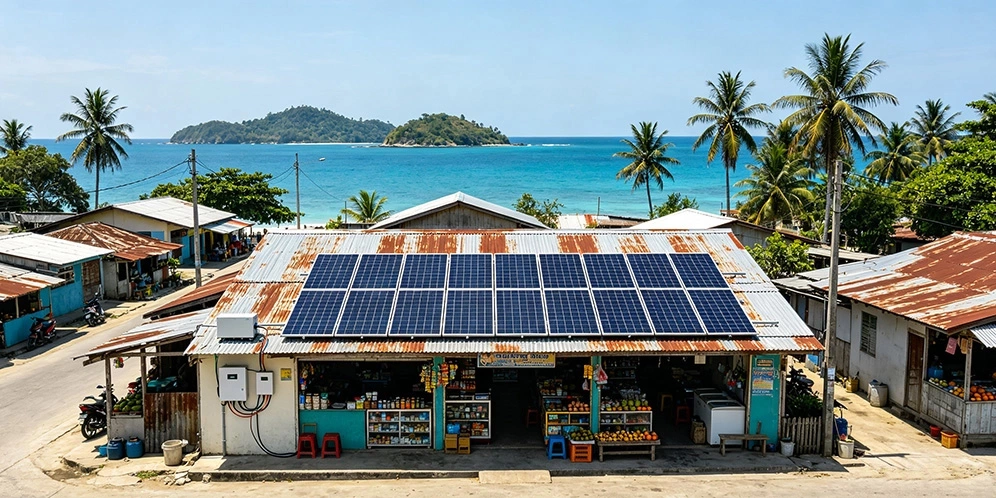
After receiving the goods, Mark spent about 3 days completing the installation (mainly debugging the inverter and battery connections). After installation, his shop had uninterrupted power 24/7.
The changes this system brought to his shop:
Lower electricity bills: Previously, his monthly diesel cost was about $150, now it's almost zero (solar power is free);
Business expansion: Neighbors, seeing his shop had uninterrupted power, started asking him, "Could you install one for us too?"
Social media coverage: He posted several before-and-after photos on Facebook, and people began sending him private messages inquiring about the system.
Within six months, he placed repeat orders with me four times:
|
Time |
Procurement Content |
Amount |
|
The first month |
2pcs solar panel+ inverter+ 2 batteries |
~$730 |
|
The second month |
4pcs solar panel+ 2pcs inverter+ 4 batteries |
~$1,400 |
|
The fourth month |
8pcs solar panels+ 4pcs inverter+ 8pcs batteries |
~$2,900 |
|
The 6th month |
20pcs solar panels+ 10pcs inverters+ 12pcs batteries |
~$6,500 |
He told me that he now installs 2-3 off-grid systems every month, mainly for:
convenience stores and small restaurants in the suburbs
small farms in the mountains
families with backup power needs
He went from an appliance repairman who "knew nothing about solar power" to a locally well-known off-grid system installer.
05: Summary: What Did Mark Do Right?
Looking back, the core reason Mark was able to build this business within six months wasn't because he had money or technical expertise, but because he did three things right:
1. Start Small, Don't Be Greedy
He didn't try to take on large projects right away. Instead, he started with his small shop, first verifying whether the product worked and how well it was used. His first order was less than $800, which was completely manageable for him.
2. Turn His Core Business into an Entry Point
He already worked in appliance repair, dealing with people who had "electricity needs." For him, the solar system wasn't a career change, but rather adding a new option to his existing business.
3. Use Results to Promote Your Business
He didn't need to spend a single penny on advertising. After the first system was installed in his shop, customers could see and touch it every day—that was the best sales tool.
05: If you're also in a similar market…
Mark's story isn't unique. In many off-grid regions of Southeast Asia, Africa, the Middle East, and Latin America, there are many small wholesalers/installers like him.
They face almost identical problems:
Unstable grid, expensive diesel
Want to enter the solar PV market but don't know where to start
Large manufacturers don't accept small orders, local sourcing is expensive and offers limited options
If you're also in a similar market and want to start with small-batch off-grid solar, feel free to contact me. I can help you:
Provide free system configuration solutions based on your budget and electricity usage scenario
Support small-batch mixed purchases (solar panels, inverters, and lithium batteries can be ordered together)
Provide simple installation guidance and basic wiring diagrams to help you get started from scratch
Even if you only need 2 panels and 1 inverter, I can help you with the setup and shipping.
Contact me:
Vevsun Energy
WhatsApp:+13025672933
 LiFePO4 vs. Lead-Acid Solar Batteries: A Comprehensive 2026 Guide
 You May Also Like

 Tel
Tel
 Email
Email
 Address
Room 340, 3rd Floor, No.69, Boai Middle Road, Shishan Town, Nanhai District, Foshan City, Guangdong, China.

Wendy
 Whatsapp