Home
HomeLiFePO4 vs. Lead-Acid Solar Batteries: A Comprehensive 2026 Guide
 Mar 29,2026

 Vevsun
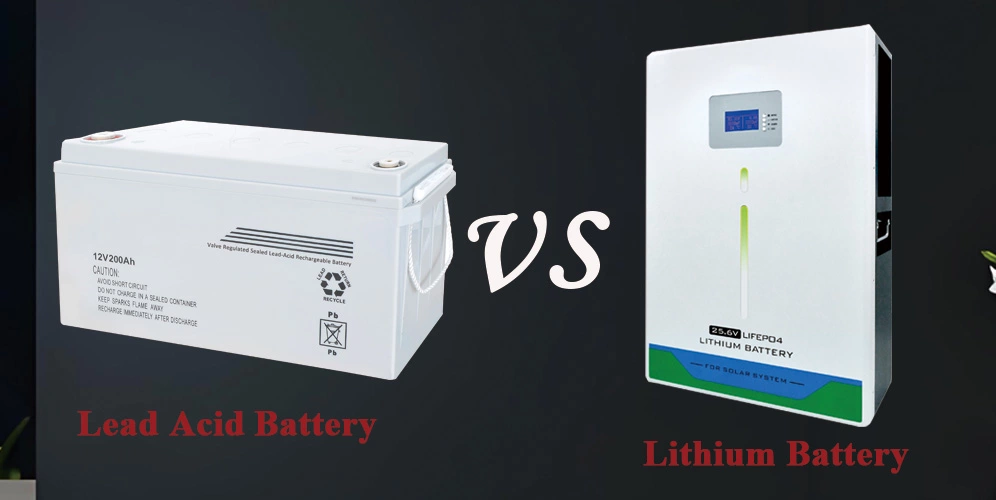
LiFePO4 vs. Lead-Acid Solar Batteries: A Comprehensive 2026 Guide
Choosing the right battery is one of the most critical decisions for any solar power system, whether for a home, an RV, or an off-grid cabin. The battery determines how much of your self-generated solar energy you can use after the sun goes down. For years, the choice was simple: lead-acid. But today, Lithium Iron Phosphate (LiFePO4) batteries have emerged as a powerful, modern alternative.
Article Guide:
1. Depth of Discharge (DoD): The Capacity Trap
2. Lifespan and Cycle Life: A Long-Term Investment
3. Efficiency and Charge Speed: Wasting Less Sunshine
4. Maintenance, Safety, and Practicality
5. Total Cost of Ownership: The Financial Verdict
6. System Comparison
7.Conclusion: How to Choose
8.Suggestion
This guide provides an in-depth comparison of LiFePO4 vs. Lead-Acid batteries for solar storage, cutting through the technical jargon to help you make the best choice for your energy needs and budget.
At a Glance: Key Differences
Before diving into the details, here’s a high-level summary of how the two technologies compare. As one source aptly puts it, "A 10kWh lead-acid battery isn’t a 10kWh battery in practice. You can only safely use half of it".
|
Feature |
Lead-Acid Battery |
LiFePO4(Lithium) Battery |
|
Usable Capacity (DoD) |
~50% |
80-100% |
|
Cycle Life |
300-1500 cycles |
2000-6000 cycles |
|
Round-Trip Efficiency |
70-85% |
92-98% |
|
Relative Weight |
Very Heavy (~45-50kg per usable kWh) |
Lightweight(~12kg per usable kWh) |
|
Upfront Cost |
Low |
2-3x Higher |
|
Lifespan (Years) |
3-5 years |
10-15+ years |
1. Depth of Discharge (DoD): The Capacity Trap
The Depth of Discharge (DoD) is the most important factor in comparing usable energy. It indicates the percentage of a battery's total capacity that can be used without causing long-term damage.
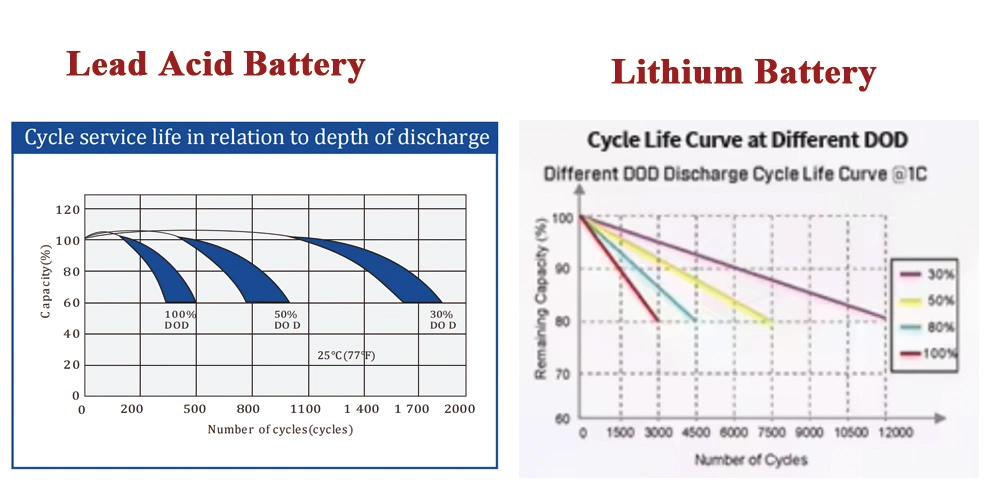
Lead-acid batteries have a fragile chemistry. Draining them too deeply causes a process called sulfation, which permanently reduces capacity and lifespan. To preserve their already short service life, manufacturers universally recommend a DoD of only 50% . This means a 10kWh lead-acid bank effectively provides just 5kWh of usable power.
LiFePO4 batteries are built for deep cycling. A high-quality LiFePO4 battery can safely and regularly use 80% to 100% of its total rated capacity without significant degradation . A 10kWh LiFePO4 battery delivers 8-10kWh of usable energy every single day.
The implication is clear: to get 10kWh of usable power from a lead-acid system, you would need to buy and maintain a bulky 20kWh bank. This initial cost advantage for lead-acid quickly evaporates.
2. Lifespan and Cycle Life: A Long-Term Investment
A solar battery is a long-term investment, and its value is best measured by how many charge/discharge cycles it can deliver over its lifetime.
- Lead-Acid batteries typically offer between 300 and 1,500 cycles, depending on the type and how well they are maintained . In a daily-use solar system, this translates to a lifespan of only 3 to 5 years .
- LiFePO4 batteries excel in longevity. A quality LiFePO4 battery provides 2,000 to 6,000 cycles or even more at a high DoD . For a home using the battery daily, this means 10 to 15+ years of reliable service . You could replace a lead-acid battery three times before you need to replace a single lithium unit .
3. Efficiency and Charge Speed: Wasting Less Sunshine
Round-trip efficiency measures how much energy you get back from the battery compared to how much you put in.
Lead-acid batteries are less efficient, with ratings between 70% and 85% . Up to 15-30% of your valuable solar energy is lost as heat during the charge and discharge process.
LiFePO4 batteries are exceptionally efficient, with ratings of 92% to 98% . You get back almost all of the energy you store.
Furthermore, LiFePO4 batteries accept a charge much faster than lead-acid . On a partly cloudy day, a lithium battery can quickly charge during a brief period of strong sun, ensuring you have power for the evening. A lead-acid battery, with its slow, multi-stage absorption charge, may never reach a full charge in the same conditions .
4. Maintenance, Safety, and Practicality
The day-to-day experience of owning these two battery types is vastly different.
Maintenance: Flooded lead-acid (FLA) batteries require regular work: checking water levels, cleaning terminals, and performing equalization charges . While sealed AGM/GEL lead-acid batteries reduce this, they still need careful charge management. LiFePO4 batteries are completely maintenance-free . An integrated Battery Management System (BMS) automatically handles cell balancing and protection.
Safety: LiFePO4 chemistry is the safest lithium-ion technology for homes . It is chemically and thermally stable, with a very high resistance to thermal runaway—a chain reaction that can cause fires in other lithium chemistries . However, proper installation and a functional BMS are still critical for safety . While generally safe, lead-acid batteries contain corrosive sulfuric acid and can emit explosive hydrogen gas, requiring ventilation .
Space and Weight: Lead-acid batteries are incredibly heavy and bulky. A lead-acid bank can be up to four times heavier than a LiFePO4 bank with the same usable capacity . LiFePO4's high energy density allows for sleek, wall-mounted installations that save valuable space .
5. Total Cost of Ownership: The Financial Verdict
The higher upfront cost of LiFePO4—typically 2-3 times that of lead-acid—is the single biggest barrier for many buyers . However, focusing only on the initial price is misleading.
When you consider the total cost over the system's life, the scales tip dramatically in favor of lithium.
Cost per Cycle: Because a LiFePO4 battery lasts 3-5 times longer and provides nearly double the usable energy per cycle, its cost per kWh cycled over its lifetime is 60-70% lower than lead-acid .
Avoiding Hidden Costs: With LiFePO4, you avoid the cost and hassle of multiple battery replacements, the energy waste from lower efficiency, and the potential labor costs for maintenance .
A 10kWh LiFePO4 system might cost $7,000 once and last 15 years. A comparable lead-acid system might cost $2,500 initially, but require replacement every 3-4 years, totaling $7,500 or more over the same 15-year period .
Taking a 5kW/48V Solar System as an Example Assuming a 5kW off-grid solar system is configured with a 48V battery pack, the selection and matching methods of the two types of batteries are compared as follows:
|
Comparison |
Lead-acid battery solutions |
Lithium battery solutions |
|
Battery Configuration Examples |
12V/200Ah, 4pcs |
51.2V 200Ah, 1pc |
|
Nominal total capacity |
12Vx200Ahx4=9.6kWh |
51.2Vx200AH=10.24kWh |
|
Actual usable power |
Approximately 4.8 kWh (To extend lifespan, it is recommended that the depth of discharge (DoD) not exceed 50%.) |
Approximately 8.2 kWh (BMS management system typically allows 80% DoD) |
|
Installation Precautions |
A 48V system requires four 12V batteries connected in series. Battery capacities of 100AH, 150AH, and 200AH can be used, tailored to customer requirements. If the customer wants to use eight 12V 100Ah batteries, the batteries must be divided into two groups of four, each group connected in series, and then the two groups connected in parallel. |
Battery voltage matching: Single battery module, easy installation.
When selecting, pay attention to system voltage compatibility. Use a 25.6V lithium battery for a 24V system, and a 51.2V lithium battery for a 48V system. |
Differences in Solar Generator Installation: Size, Weight, and Transportation
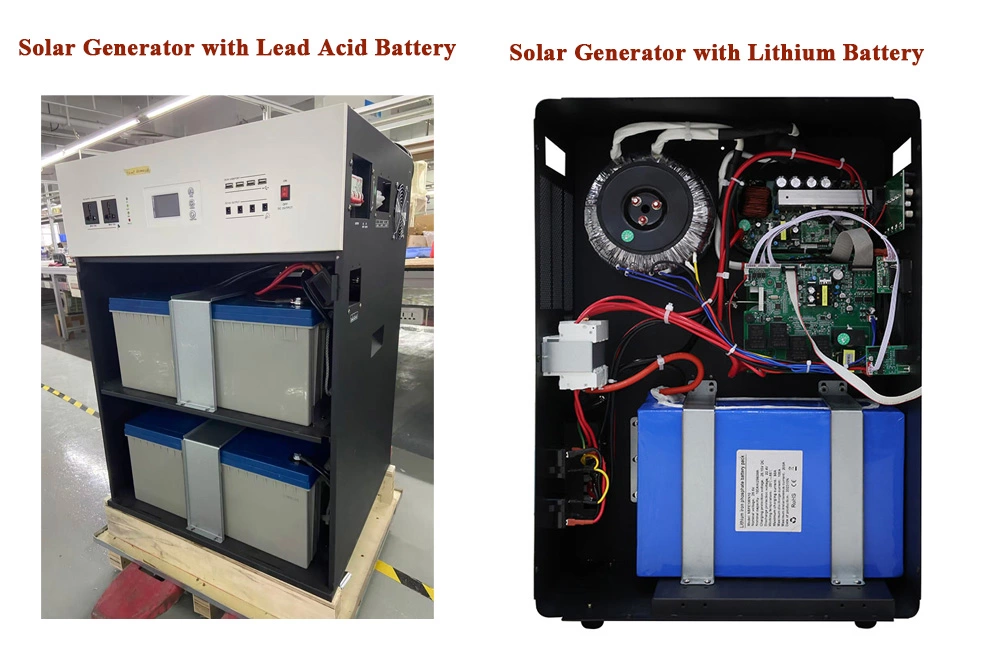
- Generators with Built-in Lead-Acid Batteries: Bulky and Heavy
Low Energy Density: Only 30-40 Wh/kg, resulting in large battery volume and heavy weight.
Example of Quantity and Weight: For example, a 24V generator requiring two 100Ah lead-acid batteries would have a single battery weighing approximately 30-35kg, resulting in a total weight of 60-70kg.
Impact on the Unit: The need for two batteries leads to a large internal space requirement, making the entire unit bulky and difficult to transport and install.
- Generators with Built-in Lithium Batteries: Lightweight and Compact
High Energy Density: Up to 110-150 Wh/kg, weighing only 1/3 to 1/5 of a lead-acid battery of the same capacity, and 30-50% smaller in volume.
Example of quantity and weight: For the same 24V/100Ah specification, typically only one battery module is needed, weighing only about 12-15kg.
Overall advantages: Fewer batteries and a smaller size result in a more compact generator structure, lighter weight, and easier handling and installation.
Additional benefits: Significantly reduced transportation costs. Whether for international logistics or last-mile delivery, lighter and smaller products can save considerable shipping costs.
- What precautions should be taken when using lithium batteries with an inverter? When using lithium batteries with an inverter,
When using lithium batteries with an inverter,
a. Core Safety and Compatibility: A certified energy storage system must be used.
This is the most important safety principle. Always purchase a complete energy storage system that has passed safety certifications (such as UL 9540 standard), rather than assembling a lithium battery and inverter yourself.
Why? Lithium batteries can release fault currents up to 50 times their rated current during a short circuit. If a standard inverter designed only for solar panels is connected to a lithium battery, a short circuit could cause the enormous current to instantly destroy the inverter, leading to fire and electric shock risks.
Conclusion: The inverter must be clearly labeled as compatible with the battery and compatible with the lithium battery's Battery Management System (BMS).
b. Technical Parameter Matching: Voltage, Current, and Communication Protocol
Even if you purchase a complete system, you need to pay attention to the matching of the following parameters:
Voltage Matching: The battery pack voltage (e.g., 48V) must be within the inverter's allowed battery input voltage range.
Current Matching: Ensure the inverter's maximum charge/discharge current is not less than the battery system's maximum continuous current; otherwise, the battery performance cannot be fully utilized.
Communication Protocol: This is the "soul" of the lithium battery. The inverter needs to communicate with the lithium battery's BMS via communication protocols (such as CAN, RS485) to obtain information such as remaining battery capacity, temperature, and health status, thereby executing precise charging strategies to prevent overcharging and over-discharging and extend battery life.
c. Key Configurations: BMS, Charging Strategy, and Monitoring
BMS is the core: The lithium battery system's built-in BMS is its safety brain, responsible for monitoring the status of each cell and ensuring it operates within safe limits.
Charging Strategy: Lithium batteries require a dedicated charging profile. Lead-acid battery charging modes cannot be used, as this will severely damage the lithium battery. These settings are typically configured in the inverter or charging controller.
Continuous Monitoring: Utilizing the inverter's monitoring function to continuously observe the battery's charge/discharge status and system operation is a good practice to ensure long-term stable system operation.
The choice between lead-acid and LiFePO4 ultimately depends on your specific application and priorities.
Choose Lead-Acid if:
- You have an extremely tight initial budget.\
- Your system is for occasional use, such as a weekend cabin or a simple backup that isn't cycled daily .
- You have unlimited space and a structure that can support immense weight, and you are willing to perform regular maintenance .
Choose LiFePO4 if:
- You want the best long-term value and lowest total cost of ownership.
- Your system is used daily (e.g., a primary residence, full-time RV) .
- You need a compact, lightweight, and maintenance-free solution.
- You want a safe, clean, and modern energy system that will last for well over a decade .
For the vast majority of modern solar applications, especially grid-tied homes with daily cycling, LiFePO4 is the superior choice. It turns solar storage into a true "set it and forget it" investment, delivering more usable power, greater efficiency, and ultimate peace of mind.
Comparison of Lead-Acid and Lithium-ion Batteries in Solar Solar Systems
The choice between lead-acid and lithium-ion batteries in solar systems not only affects initial investment but also system efficiency, ease of installation, and long-term operating costs. The following is a detailed comparison from two perspectives: system compatibility and generator integration.
 What's The Difference Between PWM and MPPT Solar Charge Controller?
 You May Also Like

 Tel
Tel
 Email
Email
 Address
Room 340, 3rd Floor, No.69, Boai Middle Road, Shishan Town, Nanhai District, Foshan City, Guangdong, China.

Wendy
 Whatsapp